
The Higher or Lower Game
Lacuna 5Trivia
4.531.00 Reviews
- Version
- 15.6.0
- Installs
- 100.00K
- Age Rating
- Everyone
Screenshots
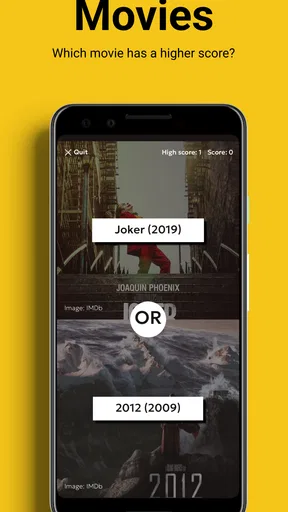
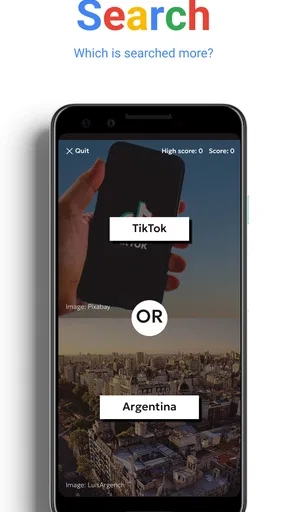
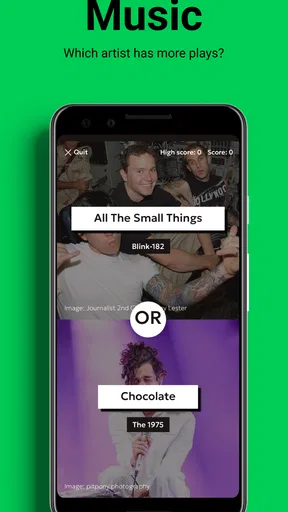
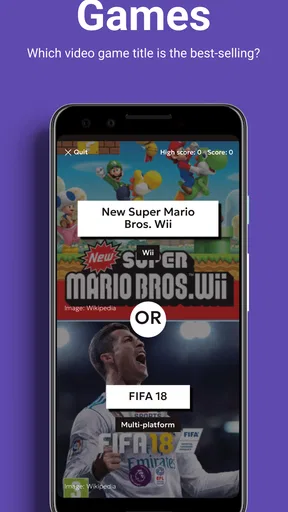
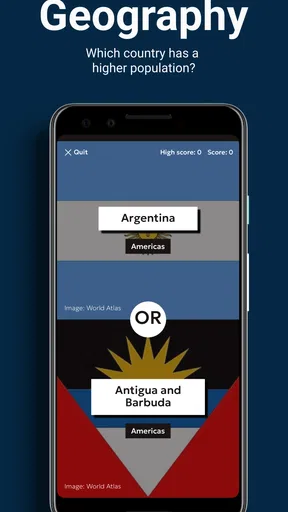
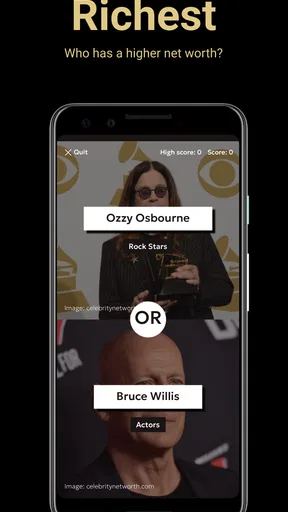
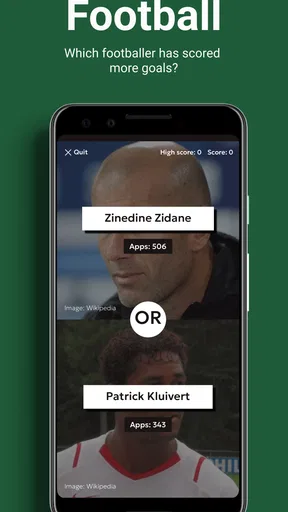
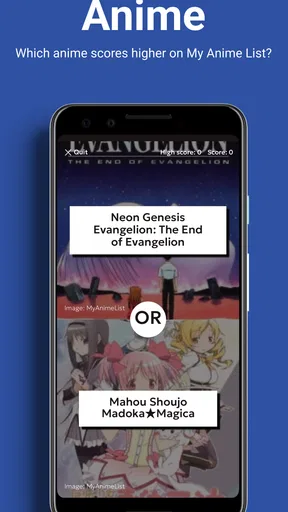
Our Review of The Higher or Lower Game
 Analysis by Appyee
I spent time with The Higher or Lower Game as a quick-fire trivia title built around a very simple question: can I judge whether the next answer should be higher or lower? That simplicity is its biggest strength. I can start a round without learning a complicated ruleset, yet the short decisions still create enough tension to make an ordinary wait or quiet evening more engaging.
This is a game from Lacuna 5, listed as free to download and aimed at Everyone. Its store summary presents it as a collection of more than one hundred trivia games, while the short description focuses on the higher-or-lower format. That combination matters: I would not approach it as one long quiz campaign, but as a broad set of small trivia sessions that are easy to pick up and leave.
The game has reached over one hundred thousand installs and holds a 4.5 average from around one and a half thousand ratings. Those figures suggest that the concept has found a real audience, although they do not replace personal taste. Some players will enjoy the quick guessing rhythm immediately; others will find the format too dependent on general knowledge and probability.
How the higher-or-lower idea works in everyday play
The appeal comes from making a decision before seeing the next result. Instead of answering a long question in a traditional quiz, I compare what is already on screen with what may come next. That creates a useful middle ground between knowledge and instinct. Even when I am unsure, I still have to commit, and that small moment of uncertainty gives the round its energy.
I found the format particularly suitable for short sessions. It works when I have only a few minutes, because I do not need to remember a story, build a team, or prepare a strategy before playing. A person waiting for a bus could play a few rounds, stop without losing much progress, and return later when there is time. It also fits casual play with a friend who does not normally choose trivia games.
The important distinction is that this is not the same experience as a conventional multiple-choice quiz. In a standard trivia app, I usually search my memory for one correct response from several options. Here, I am often estimating a direction. That makes the game feel lighter and faster, but it can also make a wrong answer feel less educational. If your main goal is to study facts systematically, a dedicated learning quiz may serve you better.
The broad collection of trivia games gives the package more staying power than a single repeated question type would have. I can move between topics instead of exhausting one narrow subject. Still, the variety should be understood as a reason to explore, not a promise that every game will suit every player. Trivia preferences are personal: someone who loves history may be less interested in entertainment or everyday knowledge, while another player may prefer the mix precisely because it prevents the session from becoming predictable.
What the free entry point really offers
The most important cost detail is straightforward: the game is free to download. That makes it easy to test without committing money first. I could decide whether the pace, question style, and overall presentation fit me before considering any optional spending. For a casual trivia title, that low barrier is valuable because the right question is not “Will I finish a campaign?” but “Will I enjoy opening this repeatedly?”
There are in-app purchases priced from $1.99 to $59.99 per item. I would treat that range as a reason to check the purchase screen carefully rather than assuming every player needs to spend. The free access is the sensible starting point, while paid value depends on what each purchase unlocks and how often I expect to play. I would not call the game a bargain solely because it has a high-priced option, and I would not call it poor value simply because purchases exist.
For me, the practical value comes from using the free version as a trial. Play several short sessions, notice whether the available variety keeps the game interesting, and only then decide whether an optional purchase feels justified. This is a better approach than buying immediately because the core higher-or-lower loop is either enjoyable for you or it is not. Extra spending cannot fix a format that does not match your taste.
Parents and younger players may also appreciate the Everyone content rating as a clear sign that the game is positioned for a broad audience. That does not mean every question will be equally suitable for every family conversation, but it does make the title easier to consider for shared casual play than a trivia game aimed at older users.
Where the game earns its time
The strongest value is convenience. I do not need a long uninterrupted session to get something from it. A short run can still provide a burst of decision-making, and the higher-or-lower structure keeps the rules visible through play rather than burying them in instructions. That makes it approachable for people who normally avoid games with dense menus or complicated systems.
A second strength is the way uncertainty changes familiar knowledge. I may know that one item is generally larger, older, more expensive, or more common than another, but the game asks me to make that judgment under pressure. This turns ordinary facts into a small risk calculation. The result is not deep strategy, but it is more engaging than simply tapping through a list of questions.
A third useful quality is its potential as a social icebreaker. I can hand the phone to someone and explain the basic idea quickly. We can debate whether the next result will be higher or lower, then compare our reasoning. The game is especially effective with people who enjoy guessing but do not want the embarrassment of being tested in a formal quiz. A wrong prediction feels like part of the joke rather than a serious failure.
There is also a good way to use it as a warm-up. Before a longer board game, a family quiz, or a study break, I can play a few rounds to get everyone making quick comparisons. I would not use it as a replacement for structured revision, but it can make a group more willing to participate. The low learning curve means nobody has to spend the first several minutes asking how the game works.
The current version is 15.6.0, and the minimum operating system is Android 7.0. That gives the game a relatively accessible technical starting point for people using older Android devices, although actual comfort will still depend on the phone and the way it handles the game. The version information is useful when deciding whether an older device is worth trying before spending time on installation.
Tradeoffs that become clearer after playing
The same simplicity that makes the game welcoming can limit its depth. I enjoyed the fast decisions, but I would not expect the strategic richness of a full quiz league, a role-playing game, or a detailed puzzle title. Once I understand the pattern, the main challenge remains judging the next comparison. Players looking for character development, long-term planning, or a strong sense of progression may find the experience too lightweight.
Knowledge gaps can also affect the feeling of fairness. If I have never encountered a subject, I may be guessing rather than reasoning. That is not necessarily a flaw in a trivia game, but it changes the mood. I am more likely to enjoy a miss when I can understand why the correct answer was higher or lower. If the game does not give enough context after every mistake, players who want explanations may leave feeling entertained but not much wiser.
The format can become repetitive if I play for too long in one sitting. My best sessions were short because the decision loop stayed fresh. After an extended run, the quick judgments can start to blur together. I recommend treating it like a snack rather than a full meal: return when you want a few minutes of trivia instead of forcing a marathon session.
Another tradeoff concerns spending. The game is free, but the presence of purchases means I would pay attention to what is optional and what is necessary for the way I want to play. A player who only wants occasional entertainment may find the no-cost access sufficient. A dedicated player may value additional content or convenience, but that value is personal and should be judged against actual use, not against the existence of a purchase button.
I also would not choose this title when I need a completely quiet, focused learning tool. Its strength is quick judgment and casual entertainment, not a carefully organized curriculum. For exam preparation, vocabulary building, or subject-specific practice, a specialist app with explanations and progress tracking would be a better fit. The Higher or Lower Game works best when the goal is to have fun with knowledge, not to master a syllabus.
Small habits that make sessions better
I get more from the game when I pause briefly before tapping. The first impulse is often based on a vague impression, but taking a second to identify the comparison can turn a random guess into an informed estimate. I ask myself whether I know the subject, whether I am relying on a familiar stereotype, and whether the previous result is making me overconfident. That tiny routine makes the game feel more interactive without adding complicated rules.
I also recommend playing with a “confidence” mindset, even if the game does not require one. Before each choice, I silently rate my certainty as high, medium, or low. High-confidence mistakes show where my assumptions are weak; low-confidence successes show where the odds were favorable. This turns a simple run into a more interesting reflection on how I judge information.
For group play, I would have each person state a reason before the answer is revealed. The best part is often not the tap itself but the explanation: one player may remember a fact, another may infer from context, and another may simply take a risk. This approach keeps less knowledgeable players involved and prevents the strongest trivia player from dominating every round.
Short sessions are another practical advantage. I would use it during a coffee break, while waiting for food, or as a five-minute reset between tasks. I would avoid opening it when I need to protect my attention for a demanding job, because quick rounds can encourage “just one more” decisions. The game is easy to start, which is convenient, but that same convenience can make it harder to stop than a longer game with a clear endpoint.
Who should install it and who should pass
I think it is a good choice for casual trivia fans who enjoy comparisons, quick guesses, and a wide mix of subjects. It is also a sensible option for families or friends who want something that can be explained in moments. The Everyone rating and free starting point make the decision low risk, particularly when several people have different gaming habits.
It suits players who prefer flexible entertainment over a fixed campaign. You can approach it as a quick distraction, a social challenge, or a way to test how well your general knowledge matches your instincts. The collection of more than one hundred trivia games is especially useful for someone who gets bored with a single repeated format and wants room to move around.
I would be more cautious about recommending it to serious quiz competitors. If you want detailed scoring analysis, formal competition, deep explanations, or a long-term training plan, the usual dedicated quiz alternatives are likely to be stronger. Likewise, if you dislike uncertainty and want every question to have a clear route to the answer, the higher-or-lower structure may feel arbitrary rather than exciting.
It is also not the best match for someone who wants a story-driven mobile game. There are no reasons here to expect the emotional investment of an adventure or the planning of a strategy title. Its identity is deliberately narrow: make a quick comparison, accept the result, and continue while the session remains enjoyable. That focus is a benefit for the right player and a limitation for everyone else.
My final recommendation on value
My verdict is to try it for free, especially if you want a friendly trivia game that works in short bursts. The core idea is clear, the broad collection gives the concept room to breathe, and the game can turn a few idle minutes into a surprisingly lively test of judgment. I would recommend it to a friend who likes guessing games more than formal examinations.
I would not recommend paying automatically. Because individual in-app purchases range from $1.99 to $59.99, I would first establish that I enjoy returning to the game and understand exactly what a chosen purchase adds. Free access is enough to make an informed first decision; paid value should be considered only after the game has earned regular space on your phone.
The best reason to choose The Higher or Lower Game is its low-friction mix of trivia and uncertainty. It is not a replacement for a serious learning app, a competitive quiz platform, or a deep mobile game. It is a compact, approachable way to challenge your instincts, share a few laughs, and discover how often your “obvious” answer is actually right. With Lacuna 5 behind it, a 4.5 average from around one and a half thousand ratings, and over one hundred thousand installs, it has enough audience interest to justify a test—but your own first few sessions should decide whether it deserves more of your time.
For my use, I would keep it installed as an occasional trivia break rather than a daily main game. That is a positive recommendation, just a specific one. When I want quick choices, easy group play, and no upfront price, The Higher or Lower Game does the job well. When I want structured learning, deep progression, or guaranteed factual explanations, I would choose something else.
Verdict
Strengths of The Higher or Lower Game
- Simple rules make it easy for anyone to start playing.
- Quick rounds are ideal for short breaks or casual sessions.
- Improves estimation and probability-thinking skills.
- Works well for solo play without needing other players.
- Lightweight gameplay is suitable for older or less powerful devices.
Limitations of The Higher or Lower Game
- Gameplay may become repetitive after extended sessions.
- Results can depend heavily on luck rather than strategy.
- Some versions include frequent ads between rounds.
- Limited depth may not satisfy players seeking complex challenges.
- An internet connection may be required for certain features.
Similar Picks in This Category
View All
Millionaire 2026 Quiz & Trivia
Quiz & Trivia Games by Submarine Apps4.5

Brain Test 2: Tricky Stories
Unico Studio4.7

Trivia Crack: Brain Quiz Games
etermax4.4

QuizzLand. Quiz & Trivia game
Quiz & Trivia Games by Mno Go Apps4.8

Brain Test: Tricky Puzzles
Unico Studio4.7

Logo Quiz
bubble quiz games4.5
Frequently Asked Questions
What is The Higher or Lower Game?
The Higher or Lower Game is a simple guessing game based on comparing two values. You are shown an item, number, image, or statistic and must predict whether the next one will be higher or lower. The concept is easy to understand, but the challenge increases as your streak grows. It is designed for quick sessions and casual entertainment rather than complex strategy.
How do you play The Higher or Lower Game?
Gameplay usually begins with a displayed value or item, followed by two choices: Higher or Lower. Select the option you believe correctly compares the next result with the current one. A correct answer lets you continue and build a longer streak, while an incorrect prediction normally ends the round. Before downloading, remember that the exact categories and scoring system may vary by version.
Is The Higher or Lower Game free to download and play?
The Higher or Lower Game can generally be downloaded for free, allowing users to try the main guessing mechanic without an upfront purchase. However, the app may include advertisements, optional purchases, or premium features depending on the platform and edition. It is a good idea to check the store listing for current pricing, in-app purchase details, and whether removing ads requires payment.
Can I play The Higher or Lower Game offline?
Whether the game works fully offline depends on the specific version installed. Basic rounds may be available without an internet connection if the required content is stored on the device, but advertisements, leaderboards, updates, or online challenges may require access to the internet. If offline play is important to you, check the app permissions and recent user reviews before downloading.
Is The Higher or Lower Game suitable for children?
The Higher or Lower Game is usually easy for children to understand because it relies on straightforward comparisons and quick decisions. Nevertheless, parents should review the app’s age rating, advertising policy, and any available in-app purchases before allowing younger players to use it. Some versions may also include online rankings or topics that are better suited to older audiences.
Play our best games!


